Technology solutions proven in production at some of the world’s leading organizations
Feature
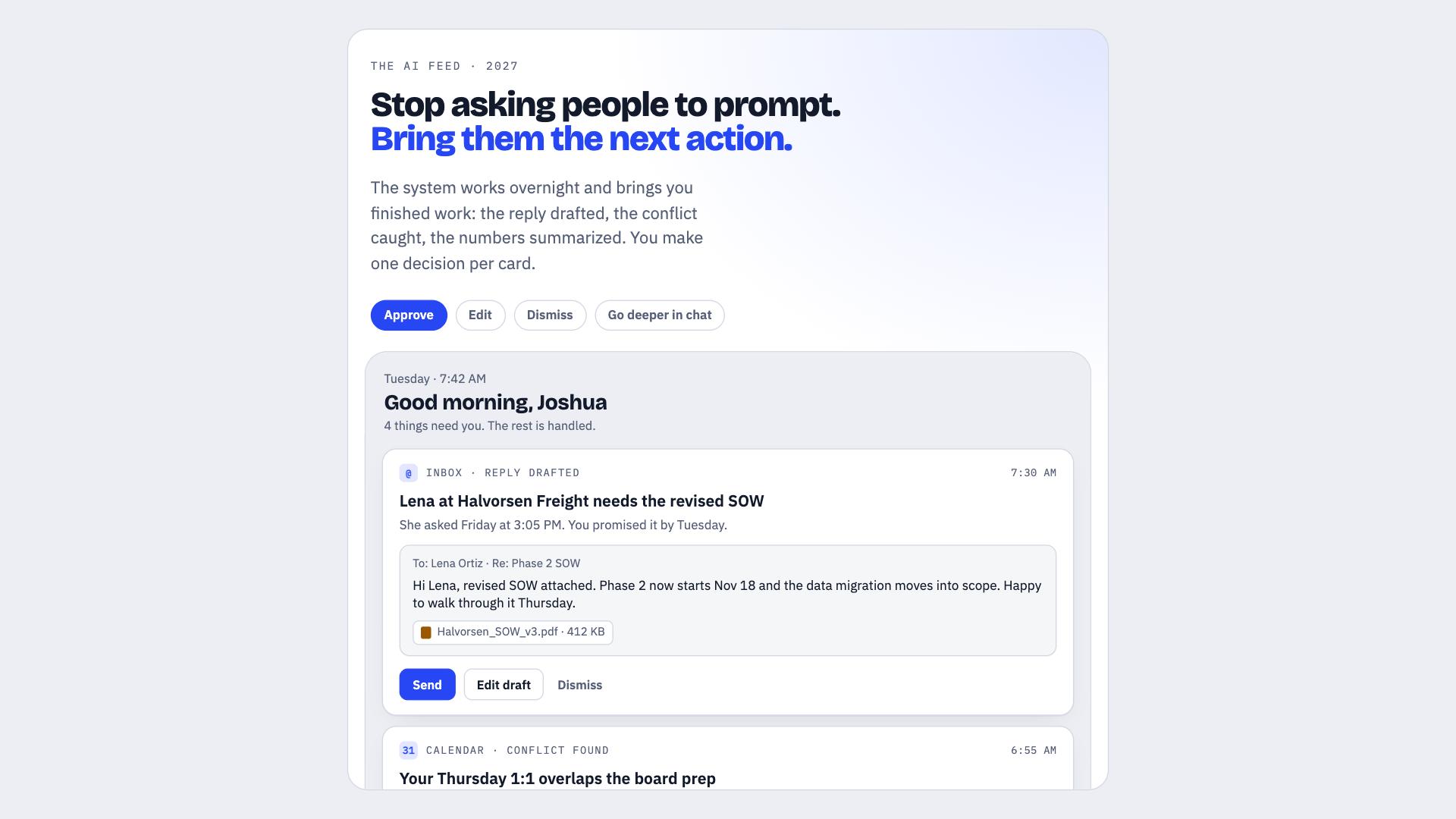
The Feed Is the Next Interface for AI Agents
Most people will never write a good prompt. The products that win 2027 will bring them prepared work to approve, one card at a time.

Most people will never write a good prompt. The products that win 2027 will bring them prepared work to approve, one card at a time.
Someone on the team will hand you a working agent before anyone asked for one. Whether it may run against the team’s work comes down to six lines you can sign, written before the prompt. This is that checklist.
A trace tells you what the agent did. Reliability depends on what happens next, and the object that step has to produce is a regression case that remembers the failure after the engineer who fixed it has moved on.
If you switched models tomorrow, what would still work? The answer tells you whether an AI program has built anything the firm owns. What survives the switch is a short list of files, and most of them are cheap to keep.
A public benchmark score measures the benchmark’s harness as much as the model, and the number moves when that harness changes. The number you need is how the system performs on your own cases, and the only way to get it is to write the eval yourself.
The case for connecting AI to a WordPress site holds when one named workflow, costed from your own records, saves more than the integration costs to build, secure, and run. Here is the worksheet, with one hypothetical example worked through so the arithmetic is checkable.
WordPress now has a native registry of what a site can do, and an official adapter that publishes a chosen subset of it to AI assistants. Connecting AI to a site has become a governance decision, made one ability at a time, with WordPress still deciding who may do what.
“RAG” names a family of retrieval designs, and the three common ones answer different kinds of questions. Sort the questions your people actually ask before anyone picks an architecture, and the choice mostly makes itself.
An agent pilot that misses usually produces a proposal for a bigger model. The cheaper diagnosis is the layer around the model, and one public experiment shows how far that layer alone can move the score.
In today’s rapidly evolving technological landscape, the ability to communicate intricate tech concepts to stakeholders is more crucial than ever.