

October 12, 2026
By
Joshua Goldfein
The AI feed will be the form factor of 2027. A feed of prepared, approvable work is how agents reach billions of people. The feed itself is the easy part. The memory, permissions, ranking, and approval logic behind each card will decide who wins.
The AI feed will be the form factor of 2027
Most people don’t know what to prompt, and they won’t prompt their way into complicated agentic workflows.
Picture your morning.
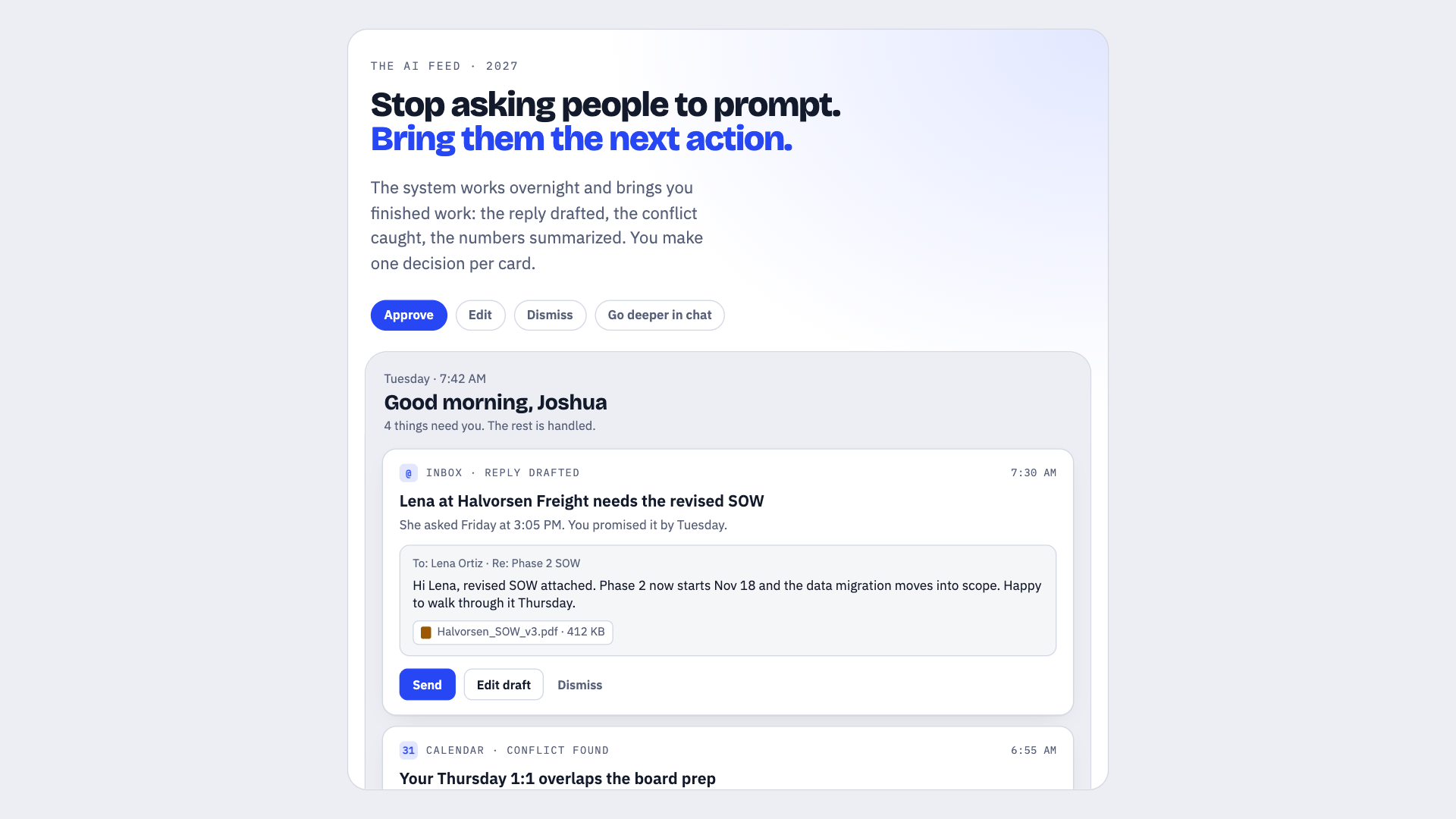
– A reply is already drafted with the right file attached.
– A calendar conflict is caught and the fix is proposed.
– Overnight sales numbers are summarized with an update ready for your team.
– At the bottom, a clearly labeled sponsored section suggests a restaurant for the client dinner you’re hosting.
You approve, edit, dismiss, or jump into chat to go deeper.
That’s the product I think wins, and here’s what it takes to build one people trust.
Chat charges a prompt tax
Chat asks every user to do four jobs before the AI does one. Figure out what the AI can do. Describe the task. Supply the context. Check the result and try again. I call it digital labor. That is a lot to ask if we want billions of people using agents every day.
Power users pay the tax happily. They know what to ask, they keep prompt libraries, and they enjoy the craft. Everyone else opens a blank box, types something vague, gets something generic, and decides AI is overhyped.
A blank text field is a discovery problem. Nobody asks for a capability they don’t know exists.
People already know how to use a feed
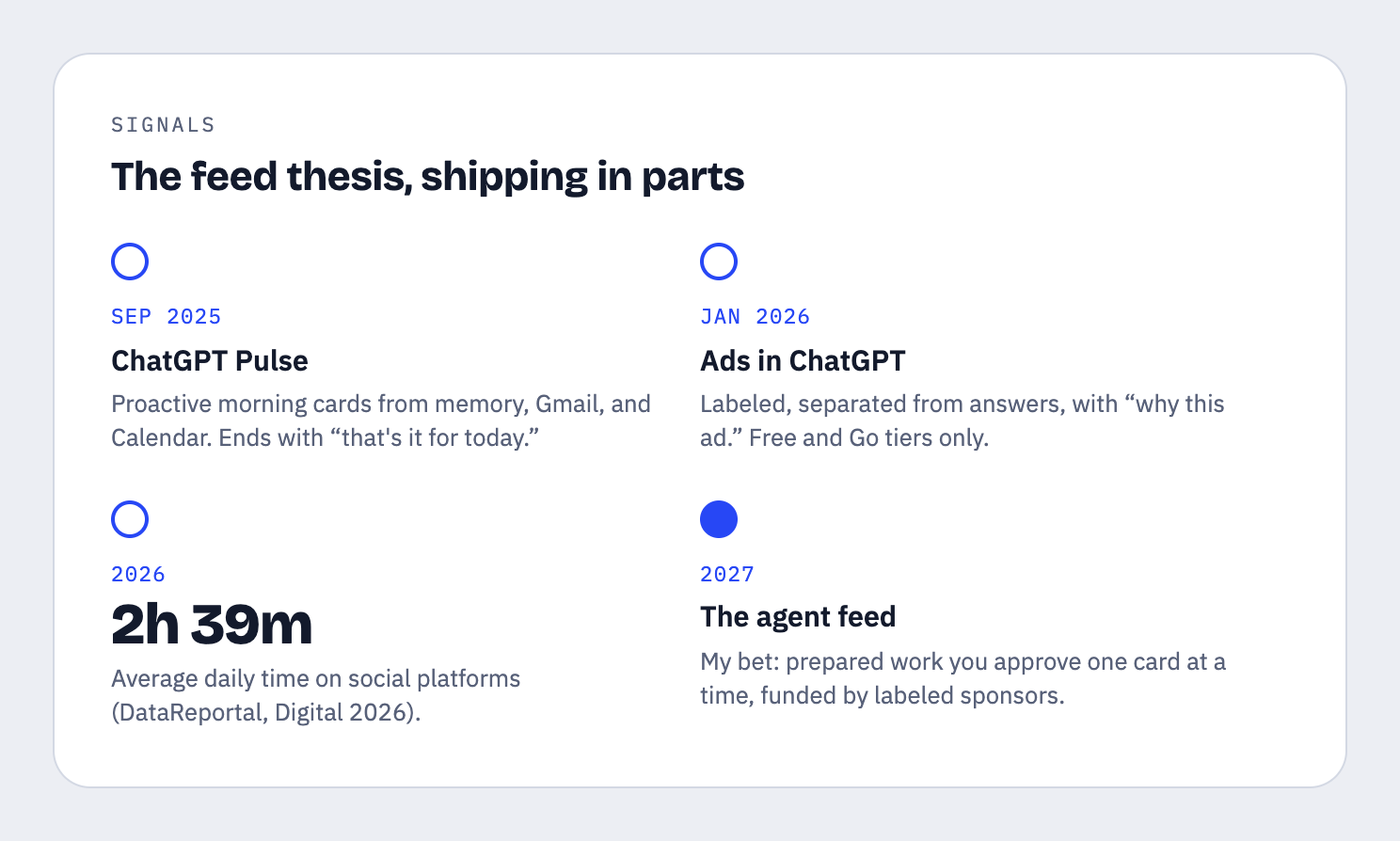
The average internet user spends 2 hours and 39 minutes a day on social platforms, according to DataReportal’s Digital 2026 report. Scroll, notice something useful, tap a button. It’s the most practiced interaction pattern on the internet, and nobody needs a tutorial.
A feed also solves discovery. Every card is a demonstration. The first time someone sees a reply drafted with the right attachment, they learn the agent can read their inbox, find the file, and write in their voice. They learned it by approving it.
Anatomy of a card that does work
A work card carries more than a social post. Five parts matter:
-
The reason
One line on why this card exists now. “She asked Friday. You promised Tuesday.”
-
The prepared work
The draft, the summary, the proposed calendar move. Finished enough to ship.
-
The provenance
Which files, numbers, and messages the agent used, so you can check them at a glance.
-
The decision
Approve, edit, or dismiss. Each one is a training signal.
-
The way out
A path into chat when the card is close and needs a conversation.
Chat keeps its place. It becomes where you go deeper, after the feed has shown you what is possible.
The market is already moving
OpenAI shipped ChatGPT Pulse in September 2025: overnight research delivered as five to ten cards each morning, drawing on past chats, memory, and connected Gmail and Google Calendar. Each day’s feed ends with a stopping point. In January 2026, OpenAI announced ads in ChatGPT for its free and Go tiers, labeled, separated from answers, dismissible, and explained. The pieces of the feed thesis are shipping one at a time.
What has to exist behind the feed
The cards are the visible 10 percent. We build agent governance systems at Mercury Digital (our AAOS platform runs agents under explicit policy and human approval), and the hard problems all sit below the screen.
-
Signals and memory
The feed is only as good as what the system knows: inbox, calendar, CRM, documents, and the promises you made inside them. “You said you’d send it Tuesday” is a memory problem before it’s a UI problem.
-
Orchestration
Each card is a finished job. A retrieval agent finds the file, a drafting agent writes the reply, a reviewer checks it against policy. Something has to schedule that work, cap its cost, and decide what runs overnight.
-
Governance
Every card is an approval gate. Some actions can run on their own. Most should wait for a person. A few should always escalate. That policy has to be written down, logged, and auditable.
| Tier | Examples | Default behavior |
|---|---|---|
| Runs on its own | File a receipt, update a CRM field, decline a duplicate invite | Act, then log it in the feed |
| Ready to approve | Send a reply, share a report, move a meeting | Prepare it, wait for one tap |
| Escalate | Payments, contracts, anything about people or pay | Flag it, require a full review |
-
Ranking by consequence
A social feed ranks by engagement. A work feed should rank by what happens if you ignore the card. The client waiting on a proposal beats an interesting article every time.
-
The edit loop
When someone edits a draft before sending it, that difference is the most valuable data in the system. Capture every edit and every dismissal. They are your roadmap.
Ads fund the agents, and test the trust
The business model is the part of this bet people push back on most. Feeds carry ads, and ads are among the biggest business models on the internet. A system that knows you’re hosting a client dinner Tuesday can suggest a table near the venue, labeled as sponsored. That’s useful.
It’s also where the model can go wrong. An agent that drafts your email and earns money from your attention has a conflict of interest. Trust depends on keeping the two visibly apart.
OpenAI’s published ad principles land in the same place: labeled, separated, dismissible, and absent from health and political conversations. Whoever builds the 2027 feed will be judged on whether those lines hold.
Where the bet could break
-
One bad auto-send
A single wrong email sent on someone’s behalf undoes months of trust. Start with approval on everything and loosen it with evidence.
-
Engagement creep
Optimize for time in the feed and you rebuild the attention trap. Pulse ending each day with a stopping point is the right instinct. A good work feed should be empty by 10 AM.
-
Permissions
A feed that drafts from email, CRM, and finance needs access to all three. Security teams will ask hard questions, and they should.
-
Depth
Complex work still needs a conversation. The feed is the front door. Chat is the workshop.
What to do now
If you run a product or an operations team, you can build toward the feed today, whether or not you ship one in 2027.
-
List the recurring decisions
Every decision your people make weekly is a card candidate.
-
Design the card before the agent
Write the reason line, the prepared work, and the buttons. If you can’t, the agent isn’t ready.
-
Write your approval tiers
Decide what runs alone, what waits for a tap, and what always escalates.
-
Log every edit
The gap between the draft and what shipped tells you what to fix next.
-
Set your sponsored policy early
Write the rules before you need the revenue.
The prompt box taught early adopters what AI can do. The feed will teach everyone else. The companies that win will treat every card as a governed decision and earn enough trust for people to approve it with one tap.
Mercury Digital helps teams find the decisions worth automating and build the governed agent systems behind them.
Start with an AI Opportunity Audit →
Sources